
Many people ask me why I chose the words Dying Hard as the primary title for the book, Dying Hard: Company B, 39th Infantry Regiment, 9th US Infantry Division. Did it have anything to do with the movie “Die Hard”? It did not, although the main character in this movie series is New York City police detective, Lieutenant John McClane, played by Bruce Willis.
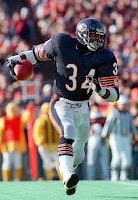
The inspiration for the title actually came from legendary professional football running back, #34, Walter Payton, of the Chicago Bears. The Hall of Famer often said: “Never die easy. Why run out of bounds and die easy? Make that linebacker pay. It carries into all facets of your life. It’s okay to lose, to die, but don’t die without trying, without giving it your best.”
Walter would expand on that: “If I’m going to get hit, why let the guy who’s going to hit me get the easiest and best shot? I explode into the guy who’s trying to tackle me.” And, “Whatever the score was, I was going to run as hard as I could on every play.” That often meant throwing a stiff arm, which was actually a vicious straight-right boxing punch, right at the face of his would-be tackler. Once, in an 8-yard run against the Chiefs, he broke half a dozen tackles. Chiefs defensive tackle John Lohmeyer said of the run: “I didn’t give up… I tried tackling him. We all did.”
As I was researching the words, I found that the phrase “die hard” was first recorded during the Battle of Albuera, on May 16, 1811, during the Peninsular War between Britain and France. During the battle fought on the border between Portugal and Spain, British Lieutenant Colonel William Inglis of the 57th (West Middlesex) Regiment of Foot was wounded by canister shot from a French artillery cannon. Cannister rounds were like big shotgun blasts and made for horrendous wounds.
Inglis himself was struck by a 4-pound grapeshot, the missile penetrating his neck and entering his shoulder, lodging in his upper back, causing severe blood loss and pain. Despite his wounds, Inglis refused to be carried off the battlefield, but remained with the regimental flag, encouraging his men with the words: “Die hard 57th, die hard!” as they came under intense pressure from a French attack. The regiment lost two-thirds of its men, but hung on and survived.
Colonel Inglis lived another 25 years. Walter Payton did not. “Sweetness” retired from pro football after the 1987 season. He died of bile-duct cancer on November 1, 1999. Walter’s rushing records have since been eclipsed. But no one ever played harder. After scoring touchdowns, Payton declined to celebrate; instead, he would often hand the ball to his teammates or the official. His posthumously published autobiography is titled Never Die Easy.
Company B would have been Walter Payton’s kind of team.